Manipulating Temporal Expectations to Accelerate Recovery After Cataract Surgery: A Randomized Controlled Trial
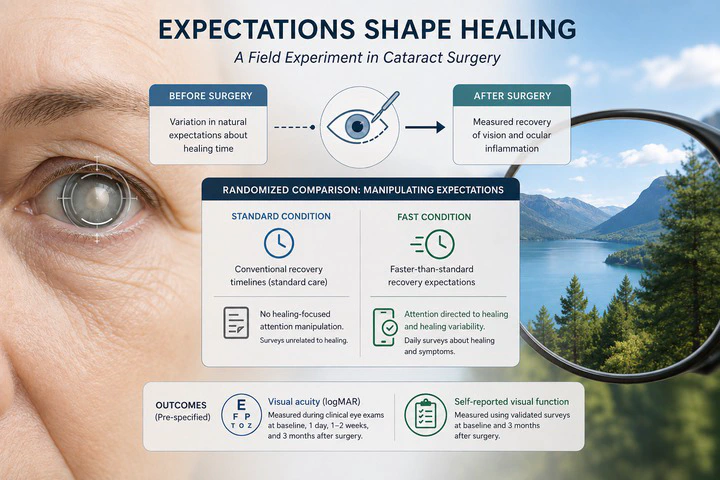 Image credit: ChatGPT
Abstract
Perceived time can objectively influence physiological outcomes, but such effects have been produced using false temporal feedback in laboratory settings, which is difficult to extend clinically. Drawing on the Embodied Models of Health (EMH) framework, in which beliefs shape health by orienting attention and expectation, the present study tested whether shifting patients’ temporal expectations could influence post-surgical recovery. Patients undergoing bilateral cataract surgery (N = 147) were randomly assigned to a fast healing condition, comprising a preoperative video emphasizing faster recovery timelines and daily surveys directing attention toward healing variability, or a standard healing condition, comprising conventional information and surveys unrelated to healing. Visual acuity was assessed at baseline and at 1-day, 1-to-2-week, and 3-month follow-ups. Group-level differences across conditions were directionally consistent but modest. The theoretically motivated analyses, however, revealed an Attention × Sensitivity interaction consistent with the framework’s core prediction: among patients who absorbed the faster expected healing times, greater daily attention to healing variability predicted faster recovery; among those who did not, attention had little effect. By the morning after surgery, and at every follow-up through three months, high-attention patients with strong healing expectations or high sensitivity to the faster-healing message held an acuity advantage over belief-matched controls equivalent to reading print roughly 10% smaller at the same distance, and reported at least 50% greater improvement in self-reported visual function. These findings provide the first clinical evidence that attention functions as a belief-weighted mediator between psychological and physiological processes, extending laboratory demonstrations of mind-body unity to clinical practice.