Reconsidering the Exclusion of Langerian Mindfulness: A Commentary on Chems-Maarif et al. (2025)
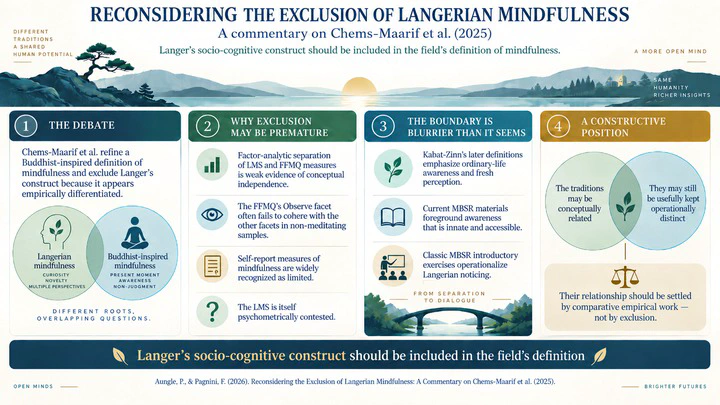 Image credit: ChatGPT
Abstract
Objectives. Chems-Maarif et al. (2025) propose a refined definition of mindfulness for psychological science and exclude Langer’s socio-cognitive construct on the grounds that it is empirically differentiated from Buddhist-inspired conceptualizations. This commentary offers a perspective on that exclusion. Methods. We examine two questions. First, what does the factor-analytic separation between the Langer Mindfulness Scale and Five Facet Mindfulness Questionnaire-family measures establish about conceptual independence? Second, how stable is the Buddhist-inspired category from which the refined definition is synthesized? We use Jon Kabat-Zinn’s evolving definitions, the current MBSR curriculum, and MBSR’s founding pedagogy as an illustrative case. Results. Scale-level separation is weak evidence of conceptual independence: the FFMQ’s own Observe facet fails to cohere with the other facets in non-meditating samples, self-report measures of mindfulness are widely acknowledged to be limited, and the psychometric structure of the LMS is itself contested. Separately, the Buddhist-inspired category is less internally stable than presented: Kabat-Zinn and the current MBSR curriculum now foreground innateness, ordinary-life awareness, and fresh perception, elements that closely parallel Langer’s account, and MBSR’s introductory exercises have operationally instantiated Langerian noticing since the program’s inception. Conclusions. The constructs may be conceptually related yet usefully kept operationally distinct. Our claim is simple: the Langerian construct belongs in the field’s definitional conversation, and the question of how the two traditions relate should be settled by comparative empirical work rather than by exclusion.