The Surprising Power of Sadness in Workplace Conflict: When Vulnerability Outperforms Dominance
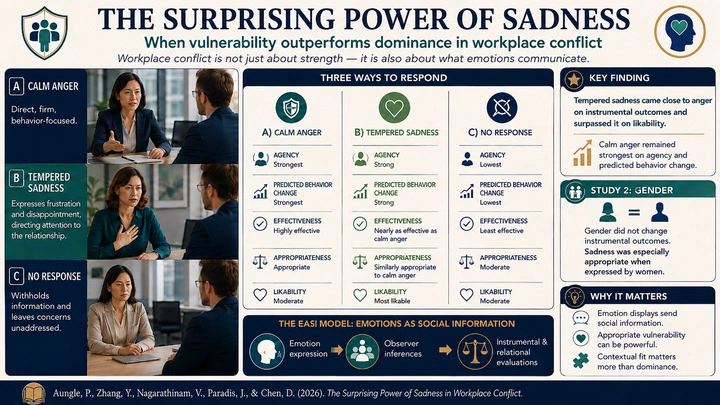 Image credit: ChatGPT
Abstract
Workplace conflict creates an emotional dilemma: employees may need to signal that a violation has occurred, yet they often fear that expressing negative emotions will make them appear unprofessional or difficult to work with. This research investigates how expressing anger, expressing sadness, or choosing not to respond during workplace conflict shapes observers’ evaluations. Drawing on the emotions-as-social-information (EASI) model, we argue that observers infer from an emotion expression what it conveys about the expresser’s control, standards, intentions, and capacity for repair. Calm, behavior-focused anger can signal agency without implying hostility or loss of control; tempered sadness can signal relational harm, disappointment, and commitment to shared standards without implying weakness; silence, though seemingly restrained, withholds the social information the target needs to recognize and repair the conflict. Two experiments tested effects on instrumental outcomes (agency, effectiveness, behavior change, status) and relational outcomes (likability, appropriateness). In Study 1, tempered sadness achieved roughly 90% of calm anger’s perceived effectiveness while matching it on appropriateness and exceeding it on likability; withholding emotion was rated least effective. Study 2 manipulated the expresser’s gender. Contrary to stereotypes penalizing ‘angry women’ or ‘sad men,’ gender did not moderate instrumental outcomes; the only reliable difference was relational, with sadness rated especially appropriate when expressed by women. These findings suggest that the contextual fit of an emotion display, rather than dominance or gender, shapes social evaluation in modern workplaces.